

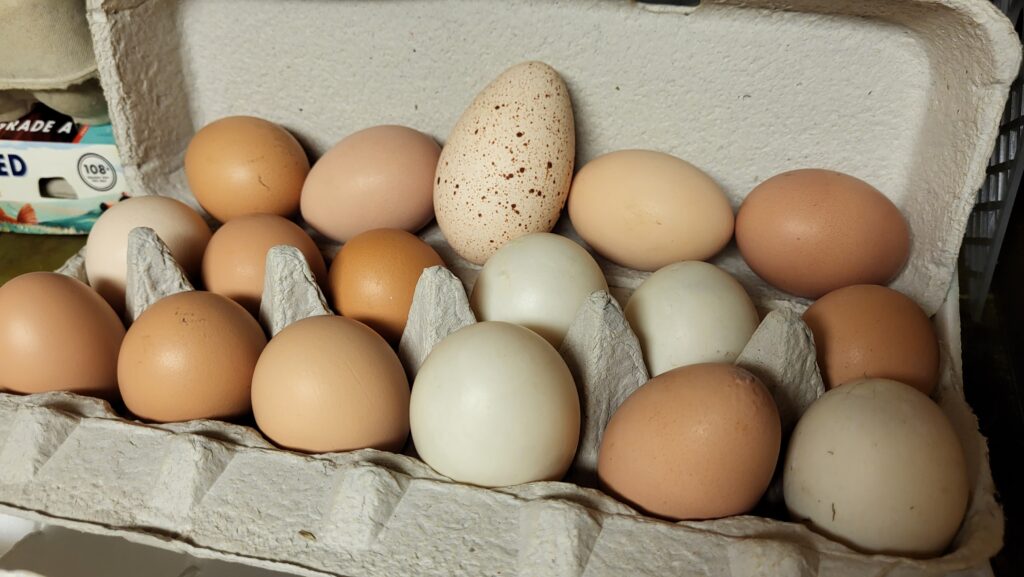
Why I care more about what went into the chicken than what somebody printed on the carton
People sometimes ask what makes a farm fresh egg different from an ordinary grocery store egg. My first answer is a question…Which farm? Because “farm fresh” doesn’t tell me nearly enough. Other questions I would ask are:
– How and where did the chicken live?
– Did she ever see sunlight?
– Did she scratch in the dirt? (and hopefully not murder your plants!)
– Did she eat plants?
– Did she chase bugs?
– What was in her feed?
– Was she eating the same thing every single day, or did she have a varied diet?
– How fresh is the egg actually?
Those questions matter to me because an egg doesn’t simply appear inside a chicken…The chicken builds it! Like humans, she builds the egg from the nutrients available to her….Which leads to a question I think we ought to ask much more often…
We Ask What’s in the Egg. Why Don’t We Ask What Went Into the Chicken?
My chickens don’t live on a scoop of generic commercial feed. I mix grains, seeds, peas and other foods that I ferment. They get mealworms, fish, seaweed and coral calcium… They forage…and because they live where I grow food, herbs and plants, they also have access to whatever seasonal goodies are available in the garden. They are chickens, so naturally they interpret the garden as a buffet created specifically in their honor…and truthfully, as long as they aren’t killing it, I won’t threaten to kill them. I mean, we ALL have to eat…not just my girls… ????
Over the years I’ve heard, sometimes through people I don’t even know personally, that people were talking about how different my eggs tasted, even compared with other local “farm fresh” eggs. I can’t put somebody’s taste buds into a laboratory and prove exactly why they preferred them….but it made me wonder………could what the chicken eats actually change what comes out in the egg? Quite a bit, actually.
And a like humans…. Garbage in, garbage out is a very real theory!
Feed Matters
Researchers have known for a long time that changing a hen’s diet can change the composition of her eggs. Not that I depend on “research” to tell me the truth. I actually listen to my hens, nature, etc….One very straightforward example is fatty acids.
When researchers change the type of fat in a laying hen’s diet, the fatty-acid composition of the yolk changes substantially too. In one controlled experiment, adding fish oil to the hens’ diet dramatically increased EPA and DHA, the long-chain omega-3 fats found in their eggs. In other words, what went into the chicken showed up in the egg. That seems obvious when you say it out loud, yet somehow we often talk about eggs as if every chicken on Earth manufactures the same standardized product regardless of how she lives.
She doesn’t.
Pasture Can Matter, Too
One study compared sister hens living on pasture with sister hens kept in cages and fed commercial mash. The pasture raised hens were still given supplemental feed, so they weren’t surviving on grass and bugs alone. But they also had access to forage.
Their eggs contained about twice as much vitamin E and long-chain omega-3 fat, about 2.5 times as much total omega-3, and a substantially lower omega-6-to-omega-3 ratio than eggs from the caged hens. And Vitamin A concentration was higher too!
That’s certainly interesting…but here’s where I don’t want to oversell the idea without being more thorough. Another controlled study found that when hens received the same feeding regimen, and the primary difference was cage versus outdoor range access…..the nutritional differences were much less dramatic and weren’t uniformly better in every category. That should tell us something important.
Pasture isn’t magic by itself
What grows in the pasture matters. What else the hens are eating matters. The season matters. The birds’ behavior matters. The entire system matters. Was the pasture sprayed? What’s growing there? Do they have access to shade and water in the summer? Etc…. Which is exactly why I don’t think the discussion should simply be, Cage bad. Pasture good.
It should be more like…What kind of life and diet produced this food?
Sunshine Goes Into the Egg, Too
This one is also super interesting! Researchers randomly assigned laying hens to indoor housing, outdoor housing, or housing where they could choose indoor or outdoor access. After 4 weeks, eggs from hens exposed to natural sunlight contained 3-4 times as much vitamin D3 in the yolk as eggs from hens kept indoors! However, this is something else to consider… Commercial eggs labeled free range that the researchers purchased separately didn’t necessarily have those same high vitamin D levels. Well, why not?
Because having access to outdoors doesn’t necessarily mean chickens actually spend meaningful time outside. The researchers concluded that outdoor systems can enrich egg vitamin D provided the environment is attractive enough that the hens actually use it. Now I personally have never met a chicken who doesn’t want to run from the cage, but apparently some chickens know there is a difference between, sure…there’s a door and there are potential threats outside of it.
The Garden Can End Up in the Yolk
Plant pigments called carotenoids are one reason yolks vary in color. USDA explains that yolk color is strongly influenced by the hen’s diet. Hens eating more yellow-orange plant pigments can produce darker yolks. And since they allegedly don’t have tastebuds, some of us feed them cayenne and other hot peppers, which can also darken their yolks. However, darker yolks don’t automatically mean healthier eggs! 🙂
Yolk color can also be intentionally manipulated through feed, too. But it does beautifully illustrate the larger point. The plant went into the chicken and something from the plant ended up in the yolk. So what plants are they eating?
A 2022 study comparing different pasture raised feeding systems with commercial cage free eggs found substantially higher carotenoids and omega-3 fats in the pasture eggs studied. But because the pasture groups also received different diets, the researchers technically could not simply say that pasture alone caused every difference. Why? Because the WHOLE food system matters!
Also newer research following pasture raised hens through different seasons found that the nutritional profile of their eggs changed as forage conditions changed throughout the year. Omega-3s, vitamins and carotenoids were not perfectly static from month to month…which actually makes perfect sense…again, like hmans…Nature isn’t a factory and a June garden is not a February garden.
Then There Is Fermented Feed
This is where things got particularly interesting to me, because fermentation is part of how I feed my own birds. Fermenting feed isn’t merely some weird crunchy crazy chicken lady ritual invented on Facebook. ???? Truth is, I honestly never even heard of it before I did it. I swear to you, THEY TOLD ME TO…and I listened. Then came the research… and wow, it’s an actual thing!
A recent meta analysis looked at 24 controlled experiments involving fermented feeds in laying hens. Overall, fermented-feed supplementation was associated with a modest increase in laying rate and some measures of internal egg quality and shell thickness…which could be the reason I have eggs in August and February, while many around me don’t.
But also note that the studies varied considerably depending on what was fermented, how much was fed, and the conditions of the experiment. The researchers rated much of the evidence low certainty, and specifically cautioned against treating “fermented feed” alone, as one uniform intervention that will automatically make your hens healthier. Individual controlled experiments have also found that certain fermented feeds CAN improve nutrient digestibility and measures of intestinal health in hens, while the results depend heavily on the ingredients and amount used. But I cannot equivocally state that, “Ferment anything and your chickens will lay super-eggs.”
But there is in fact, legitimate science behind the idea that fermentation can alter feed characteristics and, under the right conditions, influence the hen and egg.
Variety Is Probably Part of the Story
This may be one reason I think comparing “farm eggs” with “store eggs” is too simplistic. Two farmers could live three miles apart.
Both could honestly say, “These are farm-fresh eggs.” And still one flock may spend most of its life in a run eating one nutritionally complete commercial ration. And another flock may eat a balanced base diet plus forage, insects, greens, seeds and seasonal foods. Those aren’t identical inputs. And I don’t think we should expect animals receiving different inputs, living under different conditions and producing food at different levels of freshness to necessarily produce an identical egg eating experience.
The truth is that properly formulated layer ration serves an important purpose….laying hens have real nutritional requirements for protein, amino acids, calcium, phosphorus, vitamins and minerals, again just like humans. And a homemade diet can actually create nutritional deficiencies if somebody simply throws together foods that sound healthy without understanding what chickens require.
Natural doesn’t relieve us of the responsibility to know what we’re doing. This same rule applies to herbs…people and apparently it applies to chickens, too.
Imagine that? 🙂
Freshness Matters Even Before We Talk About Nutrition
There is also something farm eggs have going for them that requires almost no nutritional argument. They can be really, really fresh. As an egg ages, moisture and carbon dioxide gradually escape through the shell. The white gets thinner. The yolk becomes flatter and more fragile. The internal air cell grows larger. The USDA actually uses characteristics such as a thick firm white and high round yolk when evaluating egg quality. So when I crack an egg collected very recently and the yolk stands up beautifully while the white stays thick around it, that’s not imaginary farm mythology. That’s freshness.
And freshness alone can affect the cooking experience, texture and perception of quality. Some people claim too fresh an egg makes them harder to boil and peel? I personally am not so sure.
Better Welfare Doesn’t Need a Vitamin Excuse
There is another part of this conversation that I don’t want to hide behind nutritional numbers. Even if somebody, someday produced two eggs with exactly identical laboratory nutrient profiles, I would still care how the chickens lived. Are they raised with love or simply just treated as food? Do they get to scratch, forage, dust bathe, stretch, eat bugs, have a safe, shady place for protection…? Do they get sunshine and get to rest when they need? Do they get to argue with other chickens over something neither of them actually wanted five seconds earlier…?
Animal welfare has value even when we cannot convert it into milligrams of vitamin E. I don’t need suffering to make a measurable difference in an omega-3 analysis before I am allowed to care about suffering. And I don’t need humane treatment to produce a nutritional bonus before humane treatment becomes worthwhile.
But farm fresh doesn’t ALWAYS automatically mean safe, either!
There is one natural food myth worth discussing. A beautiful backyard egg is not magically immune to bacteria and disease. USDA claims that clean, unbroken fresh eggs can still contain diseases like salmonella, and contamination can occur before the shell forms or afterward. Proper handling still matters. Knowing your farmer is wonderful. Knowing your chickens is wonderful. However, neither one changes microbiology.
So Are My Eggs Really “Better”?
People tell me they taste better and I love hearing that. I’m proud of the life my animals have and of the care I put into what I feed them. But I’m not going to pretend I’ve sent my eggs to a laboratory and proven that mine contain exactly 2.73 times more of Nutrient X than somebody else’s.
What I can say is that the larger principle is well established, hen diet can change egg composition. Pasture can change egg composition. Sunlight can change vitamin D in eggs. Seasonal forage can affect nutrients. Fermentation can change feed and may affect certain measures of hen and egg quality. And freshness changes the physical quality of an egg.
So when somebody tells me, “An egg is an egg.” I don’t think that’s quite true. An egg has a history. There was a chicken before there was breakfast. There was healthy, varied food. There was sunlight or there wasn’t. There was soil and plants…or not. Insects, movement, safety, stress and care involved in the end result. There was an entire little living creature taking what was available to her and turning it into food to the best of her ability.
An egg is only as good as the life behind it
And maybe instead of asking only, “Are these farm fresh eggs?” We could start asking more about the chickens… Because I think the answer tells us a whole lot more than the words printed on the carton. 🙂
MYSTERY SOLVED!
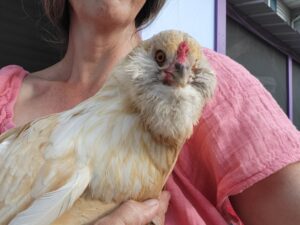
In case you ever wanted to know the truth about why the chicken decided to cross the road……?
Well……a few years ago, someone hit a chicken with their car and rather than knocking on their door, they brought it here thinking if anyone could help her, it’s me……
And she’s still here, scratching and pecking around healthfully! So I don’t care what anyone says, but I KNOW she ran out in front of that car because she wanted to get to the Ozarks Church of Nature and Magical Food Forest! 🙂
I don’t blame her…she’s not the only one that risked their life to get here! <3