
Nerve Align
Botanical Traditions, Nervous System Wellness & the Science of Calming Herbs
An Educational Exploration of Eleven Remarkable Botanicals
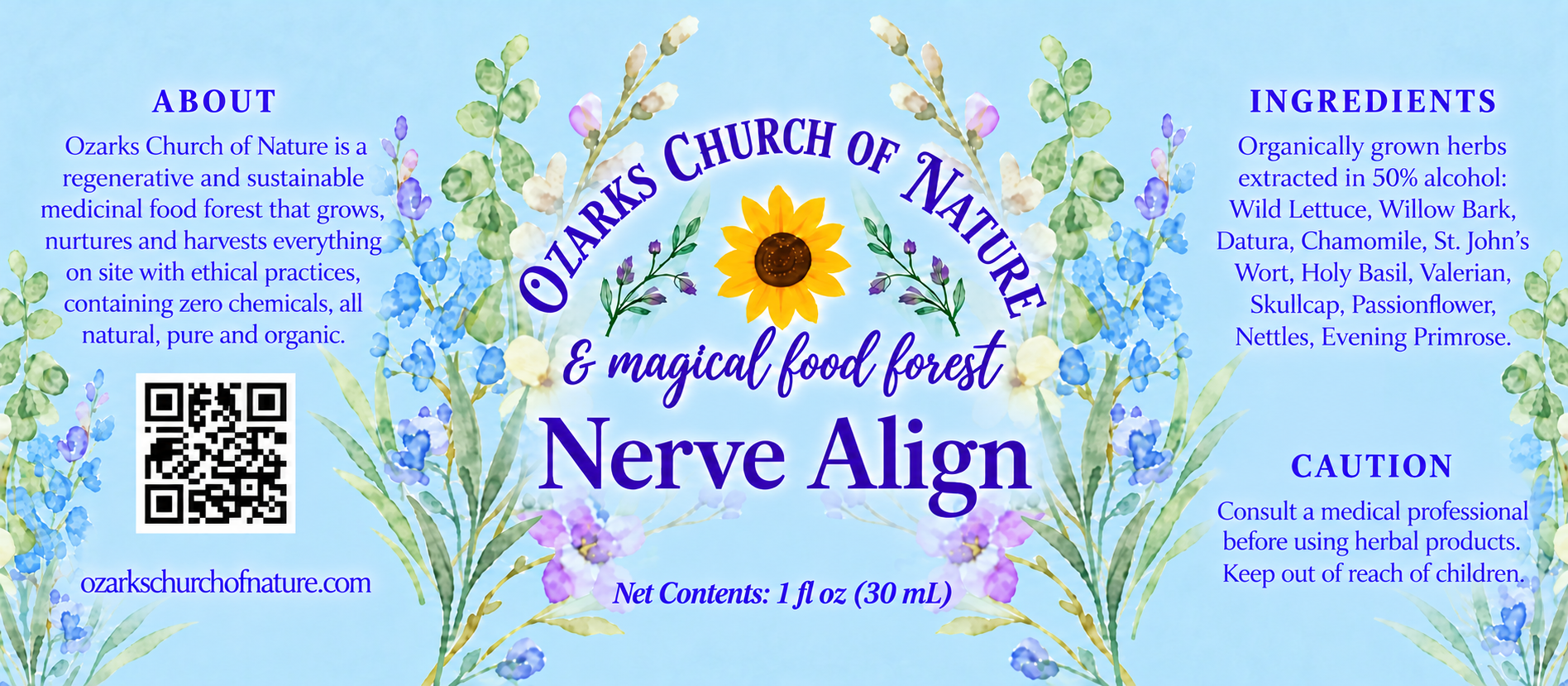
Packaging: 1 fl oz (30 mL) glass dropper bottle
Exploring the Extraordinary Human Nervous System
Our nervous system is one of the most remarkable networks in the human body. It connects our thoughts, sensations, emotions, memories, muscles, organs, and the many processes that keep us alive. For centuries, herbalists around the world have explored plants traditionally associated with rest, relaxation, nervous tension, mood, physical discomfort, and sleep.
Today, researchers investigate these plants through neuroscience, phytochemistry, pharmacology, and clinical studies.
Some contain flavonoids and aromatic compounds studied for antioxidant and anti-inflammatory activity. Others contain alkaloids that interact directly with neurotransmitter systems. Understanding the differences between them is part of what makes botanical education so fascinating!
Sympathetic vs. Parasympathetic: Fight-or-Flight and Rest-and-Digest
Our autonomic nervous system helps regulate many functions we don’t consciously control, including heart rate, breathing patterns, digestion, and glandular activity. Two of its major branches are the sympathetic and parasympathetic nervous systems.
The Sympathetic Nervous System – Fight or Flight
When we encounter danger, excitement, exertion, or stress, the sympathetic nervous system helps prepare us for action. Heart rate may increase, attention becomes more focused, and the body directs resources toward responding to the situation.
This system is essential! Without it, we couldn’t respond appropriately to the challenges of everyday life. However, prolonged stress can contribute to feelings of tension, restlessness, and difficulty winding down.
The Parasympathetic Nervous System – Rest and Digest
The parasympathetic nervous system plays an important role in digestion, heart-rate regulation, and numerous restorative functions. The vagus nerve, one of its major pathways, connects the brainstem with organs including the heart and digestive tract.
These two systems are partners rather than enemies. Both are essential, and healthy nervous-system regulation involves adapting appropriately to changing circumstances.
What Does This Have to Do With Herbalism?
Traditional herbalists have long explored plants associated with calmness, sleep, and emotional well-being. Modern researchers investigate some of these plants for their interactions with neurotransmitters such as GABA, as well as their effects on stress-related pathways.
It’s important to understand that a sedative effect is not necessarily the same thing as directly activating the parasympathetic nervous system. Nevertheless, these studies offer fascinating insights into why certain plants have remained part of traditional calming preparations for generations.
Meet the Eleven Botanicals
Wild Lettuce – Lactuca species (likely Lactuca canadensis)
Wild lettuce has a long history in traditional herbal preparations associated with nervous tension, physical discomfort, and restlessness. Its bitter latex contains sesquiterpene lactones, including lactucin and lactucopicrin, which have attracted experimental research interest for their potential analgesic and sedative properties.
Different wild lettuce species contain varying chemical profiles, making accurate identification particularly important.
Willow Bark – Salix Species
Willow bark holds a remarkable place in the history of botanical pharmacology. Traditionally associated with fever and physical discomfort, willow contains salicin and other phenolic compounds that contributed to our understanding of salicylate chemistry.
Certain standardized willow bark extracts have been investigated in clinical studies involving musculoskeletal pain. Willow bark is not identical to aspirin, however, and salicylate-related precautions, including potential bleeding risks remain important.
Chamomile – Matricaria chamomilla / Matricaria recutita
Few herbs are as closely associated with quiet evenings and bedtime traditions as chamomile. Its beautiful daisy-like flowers contain flavonoids, including apigenin, that have attracted research interest for their interactions with biological pathways involved in relaxation.
Clinical studies have explored chamomile preparations for anxiety and sleep-related concerns, although results vary. Chamomile reminds us that even the most familiar garden flowers can contain wonderfully complex chemistry.
St. John’s Wort – Hypericum perforatum
Recognizable by its brilliant golden blossoms, St. John’s wort has a long history in European herbal traditions involving mood and emotional well-being. Its compounds, including hyperforin and hypericin, have been extensively studied.
Certain standardized extracts have demonstrated benefits in some clinical studies involving mild-to-moderate depression, although outcomes vary by preparation and study. St. John’s wort is also especially important in the study of herb–drug interactions, as it can significantly alter how the body processes numerous medications.
Holy Basil (Tulsi) – Ocimum tenuiflorum
Tulsi holds deep cultural and spiritual significance in South Asia and has long been associated with traditional wellness practices. Its naturally occurring compounds include eugenol, rosmarinic acid, and other phytochemicals.
Researchers have explored holy basil in relation to stress responses, antioxidant mechanisms, inflammatory pathways, and metabolic processes. Human research remains limited, but its chemistry and cultural history make it a particularly interesting member of the mint family.
Valerian – Valeriana officinalis
Valerian root has been part of European herbal traditions for centuries, particularly in preparations associated with restlessness and sleep. Its constituents include valerenic acids, which researchers have investigated for interactions with GABA-related signaling.
GABA is an important inhibitory neurotransmitter involved in regulating neuronal activity. Although valerian remains a popular subject of sleep research, clinical studies have produced mixed findings.
Skullcap – Scutellaria lateriflora
American skullcap has a longstanding place in North American herbal traditions associated with nervous tension, relaxation, and rest. Its flavonoids have attracted scientific attention for possible interactions with pathways involved in stress and calming responses.
Research remains preliminary, and accurate identification matters because American skullcap and Chinese skullcap are different species with different traditional applications.
Passionflower – Passiflora incarnata
Passionflower is one of nature’s most extraordinary flowers, with intricate blossoms that have fascinated gardeners and herbalists alike. Traditionally associated with relaxation, nervous tension, and sleep, passionflower contains flavonoids that have attracted research interest for their possible effects on anxiety-related pathways.
Small human studies have investigated passionflower preparations in relation to anxiety and sleep, although further research is needed. Its beautiful appearance is only one part of its fascinating botanical story!
Stinging Nettle – Urtica dioica
Nettle is both a traditional food plant and a fascinating subject of nutritional and phytochemical research. Its leaves contain minerals, polyphenols, and other plant constituents studied in relation to antioxidant activity, inflammation, and metabolic processes. It is known to be strengthening, which is why we added it to this blend.
Researchers have investigated different nettle preparations for a variety of biological effects. The leaves, roots, and extracts differ considerably in composition, demonstrating why the specific plant part matters.
Evening Primrose – Oenothera biennis
Known for its beautiful yellow evening-opening flowers, evening primrose also has an interesting place in research involving fatty-acid metabolism. Its seeds contain oil rich in linoleic acid and gamma-linolenic acid (GLA).
These fatty acids participate in biological processes involving cell membranes and inflammatory signaling. Most clinical research has involved evening primrose seed oil rather than its leaves or flowers, an important distinction when comparing different herbal preparations.
Datura – Datura Species
Few plants have such a fascinating and complicated history as datura. With its dramatic and fragrant night blooming, trumpet-shaped flowers and unusual seed capsules, this member of the nightshade family has held medicinal, cultural, and spiritual significance in several traditions.
In parts of South Asia, datura is associated with Lord Shiva, while certain Indigenous traditions of the Americas have incorporated particular datura species into sacred ceremonies and spiritual practices. These traditions differ between communities and deserve to be understood within their own cultural contexts.
Datura contains powerful tropane alkaloids, including atropine, hyoscyamine, and scopolamine. These compounds block muscarinic acetylcholine receptors and affect important nervous-system functions, especially parasympathetic signaling.
A Fascinating Connection to Respiratory Medicine
Historically, datura-containing preparations were used in certain asthma treatments. A small human study published in 1979 demonstrated bronchodilation following inhalation of a historical Datura stramonium preparation.
This anticholinergic mechanism has important connections to modern respiratory pharmacology, where precisely formulated medicines such as ipratropium and tiotropium help relax airway smooth muscle.
The study demonstrated a genuine physiological effect, but bronchodilation is not the same as curing asthma, and its findings do not establish the safety or effectiveness of oral datura tinctures.
Sacred Traditions, Altered Awareness & Neuroscience
Datura has also appeared in traditional spiritual practices involving visions, initiation, and altered states of consciousness. Its compounds can profoundly alter perception. However, hallucinations, disorientation, and toxic delirium are medically different from ordinary meditation or healthy restorative sleep. And we definitely DO NOT RECOMEND attempting to use this plant or its seeds to chase a high! RESPONSIBLE USE ONLY!
The same alkaloids responsible for datura’s pharmacological effects can cause dangerous poisoning, including impaired vision, rapid heartbeat, overheating, confusion, seizures, and potentially fatal complications.
Because concentrations differ greatly between plants, plant parts, and preparations, even a small quantity of an unstandardized tincture cannot be assumed safe.
Datura illustrates an important principle of botanical science: a plant can have genuine medicinal, scientific, cultural, and spiritual significance while also presenting serious risks.
Creating Space for Rest
Our nervous systems work continuously, adapting to our activities, emotions, and environment. Rest is not a luxury. It is part of maintaining physical and emotional well-being. Quiet evenings, adequate sleep, moments spent in nature, gentle breathing practices, and opportunities to recover from daily stress can all contribute to a more restorative routine.
Traditional herbalism offers a fascinating history of plants associated with calmness and nervous-system wellness. Modern science gives us additional tools for understanding their chemistry, physiological effects, potential benefits, and limitations.
Together, these approaches remind us that learning about plants means respecting both their remarkable properties and the responsibilities that come with understanding them.
Botanical Ingredients & Product Information
Botanical ingredients: Wild Lettuce, Willow Bark, Chamomile, St. John’s Wort, Holy Basil (Tulsi), Valerian, Skullcap, Passionflower, Stinging Nettle, Evening Primrose, and Datura.
Packaging: 1 fl oz (30 mL) amber glass dropper bottle.
Botanical collection: Ozarks Church of Nature & Magical Food Forest.
Important safety information: Nerve Align’s listed formulation contains datura, whose tropane alkaloids can cause life-threatening poisoning. The concentration in this preparation has not been established, and there is no verified safe oral dose. This formulation should not be used or marketed for ingestion without a qualified toxicological assessment. St. John’s wort also has significant medication interactions.
Explore the Research: Eleven Botanicals and the Nervous System
Traditional herbalism and modern science offer fascinating opportunities to explore how plants interact with the human body. The following studies investigate individual botanical species, standardized extracts, isolated plant compounds, and their relationships with pain, relaxation, sleep, mood, stress, inflammation, and nervous-system function.
Wild Lettuce – Lactuca canadensis
Canadian wild lettuce is a native North American member of the daisy family, traditionally grouped with other wild lettuces in botanical discussions.
Researchers have studied bitter sesquiterpene lactones, including lactucin and lactucopicrin, from related lettuce species. Experimental studies in mice have demonstrated analgesic and sedative activity, although these findings have not been established specifically for Lactuca canadensis or in human clinical trials.
Explore the Research:
https://pubmed.ncbi.nlm.nih.gov/16621374/
Willow Bark – Salix Species
Treatment of Low Back Pain Exacerbations with Willow Bark Extract: A Randomized Double-Blind Study
https://pubmed.ncbi.nlm.nih.gov/10936472/
This human clinical trial involved 210 participants with low back pain. Researchers reported improvements with a standardized willow bark extract compared with placebo. The study illustrates the clinical interest in salicin-containing botanical preparations.
Chamomile – Matricaria recutita
A Randomized, Double-Blind, Placebo-Controlled Trial of Chamomile Extract for Generalized Anxiety Disorder
https://pubmed.ncbi.nlm.nih.gov/19593179/
Researchers investigated chamomile extract in adults with mild-to-moderate generalized anxiety disorder. The findings suggested possible anxiety-reducing effects, providing an interesting connection between chamomile’s traditional calming reputation and clinical research.
St. John’s Wort – Hypericum perforatum
St. John’s Wort for Major Depressive Disorder: A Systematic Review
https://pubmed.ncbi.nlm.nih.gov/28083422/
This review examined 35 studies of St. John’s wort preparations in adults with depression. Researchers found evidence of benefits from certain standardized extracts compared with placebo, although results and preparations varied. St. John’s wort also has important medication interactions.
Holy Basil (Tulsi) – Ocimum tenuiflorum
A Randomized Clinical Trial Investigating Holy Basil Extract on Stress, Mood, and Sleep
https://pubmed.ncbi.nlm.nih.gov/36185698/
In this eight-week placebo-controlled study involving 100 adults, researchers investigated a standardized holy basil extract and reported improvements in certain measures of perceived stress and sleep, along with changes in stress-related physiological markers.
Valerian – Valeriana officinalis
Valerian Root in Treating Sleep Problems and Associated Disorders: A Systematic Review and Meta-Analysis
https://pubmed.ncbi.nlm.nih.gov/33086877/
This review examined studies investigating valerian preparations for sleep-related concerns and anxiety. The researchers explored why findings have been inconsistent, including differences in extract quality and preparation methods.
American Skullcap – Scutellaria lateriflora
American Skullcap: A Randomized, Double-Blind, Placebo-Controlled Study of Its Effects on Mood
https://pubmed.ncbi.nlm.nih.gov/23878109/
Researchers investigated American skullcap in 43 healthy volunteers using a controlled crossover design. The study explored its traditional association with calmness, stress, and mood.
Passionflower – Passiflora incarnata
Preoperative Oral Passionflower Reduces Anxiety in Ambulatory Surgery Patients: A Double-Blind, Placebo-Controlled Study
https://pubmed.ncbi.nlm.nih.gov/18499602/
This small clinical trial involved 60 patients undergoing surgery. Researchers examined passionflower’s effects on preoperative anxiety, contributing to the scientific literature surrounding this beautiful climbing herb and its traditional calming applications.
Stinging Nettle – Urtica dioica
Beneficial Effects of Stinging Nettle on Experimentally Induced Memory Impairment in Rats
https://pubmed.ncbi.nlm.nih.gov/29745257/
Researchers explored the effects of nettle extract in rats with experimentally induced memory impairment. The study investigated oxidative damage, acetylcholinesterase activity, and memory-related outcomes, reporting protective effects under the experimental conditions.
This is animal research, not a demonstration of improved human memory.
Evening Primrose – Oenothera biennis
The Effect of Evening Primrose Oil on Inflammatory Diseases: A Systematic Review of Clinical Trials
https://pubmed.ncbi.nlm.nih.gov/38360611/
This review investigated clinical research involving evening primrose seed oil, which contains gamma-linolenic acid (GLA). Researchers examined several inflammatory conditions and found mixed results, with insufficient evidence for strong conclusions across most uses.
The studies primarily concern seed oil, not whole-plant tinctures.
Datura – Datura stramonium
Bronchodilator Effects of Antiasthmatic Cigarette Smoke
https://pubmed.ncbi.nlm.nih.gov/483196/
This 1979 human study investigated inhaled historical datura preparations in twelve people with asthma. Researchers observed bronchodilation in most participants, illustrating the genuine pharmacological activity of datura’s anticholinergic alkaloids.
The findings do not establish an asthma cure or demonstrate that consuming a datura tincture is safe.
Additional Safety Resource: Jimsonweed (Datura) Poisoning — MedlinePlus
https://medlineplus.gov/ency/article/002881.htm
Understanding the Research
These publications include human clinical trials, laboratory investigations, animal studies, and scientific reviews. Some report promising findings, while others document mixed or limited evidence.
Different species, plant parts, extracts, concentrations, and methods of administration can produce very different results.
Research involving an individual plant or isolated compound does not establish the safety or clinical effectiveness of the finished Nerve Align formulation.
Because Nerve Align contains datura, an unstandardized preparation with potentially dangerous tropane alkaloid concentrations, no safe oral dose can be established from these studies.
At Ozarks Church of Nature & Magical Food Forest, we believe curiosity, traditional knowledge, and careful scientific research all have a place in understanding the remarkable world of plants.
Calming Herbs & Sleep Research
NIH — Passionflower: Usefulness and Safety
https://www.nccih.nih.gov/health/passionflower
NIH — Valerian: Usefulness and Safety
https://www.nccih.nih.gov/health/valerian
NIH — St. John’s Wort: Usefulness and Safety
https://www.nccih.nih.gov/health/st-johns-wort
Datura, Respiratory History & Toxicology
Bronchodilator Effects of Antiasthmatic Cigarette Smoke (Datura stramonium)
https://pubmed.ncbi.nlm.nih.gov/483196/
Pharmacological and Toxicological Aspects of Datura stramonium
https://pubmed.ncbi.nlm.nih.gov/23506688/
Datura stramonium in Asthma Treatment and Possible Effects on Prenatal Development
https://pubmed.ncbi.nlm.nih.gov/21783676/
MedlinePlus — Jimsonweed (Datura) Poisoning
https://medlineplus.gov/ency/article/002881.htm
These resources discuss individual plants, isolated compounds, clinical studies, historical preparations, and toxicological findings. They do not establish the safety or clinical effectiveness of the finished Nerve Align tincture.
A Lifetime of Botanical Discovery
The more we learn about plants, the more remarkable they become. Some offer fascinating examples of traditional food and herbal practices. Others help scientists investigate neurotransmitters, antioxidant systems, cellular signaling, and pharmacology.
Each has a story worth exploring.
At Ozarks Church of Nature & Magical Food Forest, we believe botanical knowledge should inspire curiosity, thoughtful questions, and lifelong learning.
Where nature, traditional knowledge, scientific curiosity, and community come together.

Reviews
There are no reviews yet.