
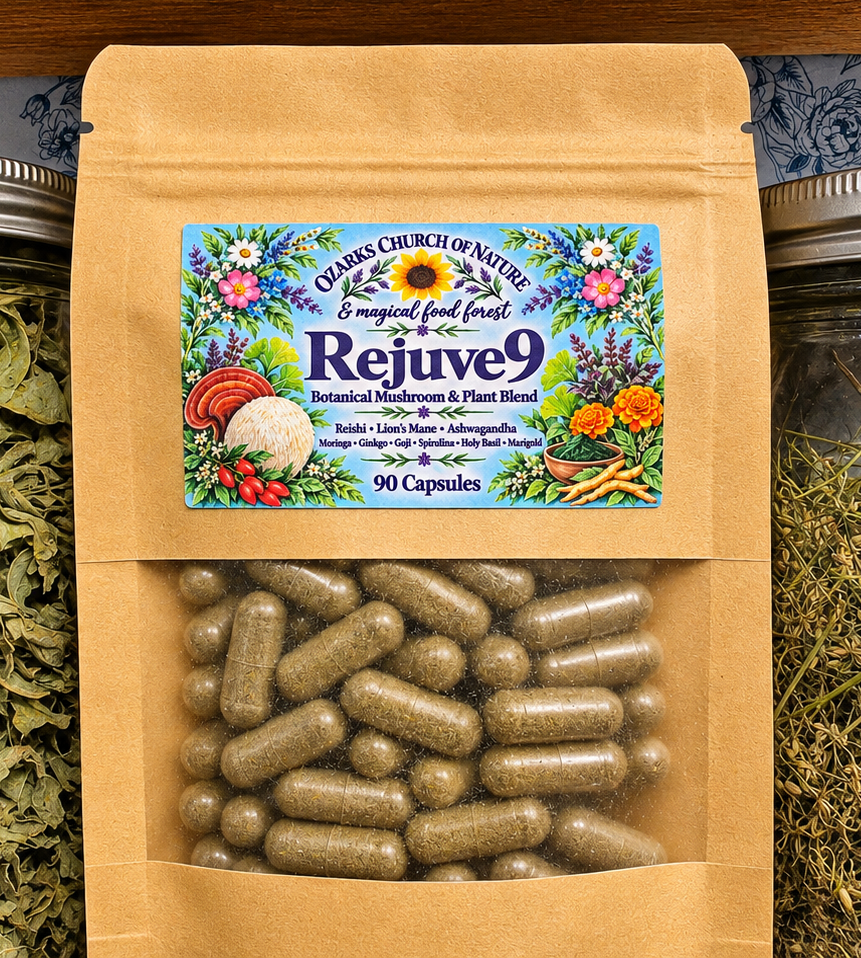
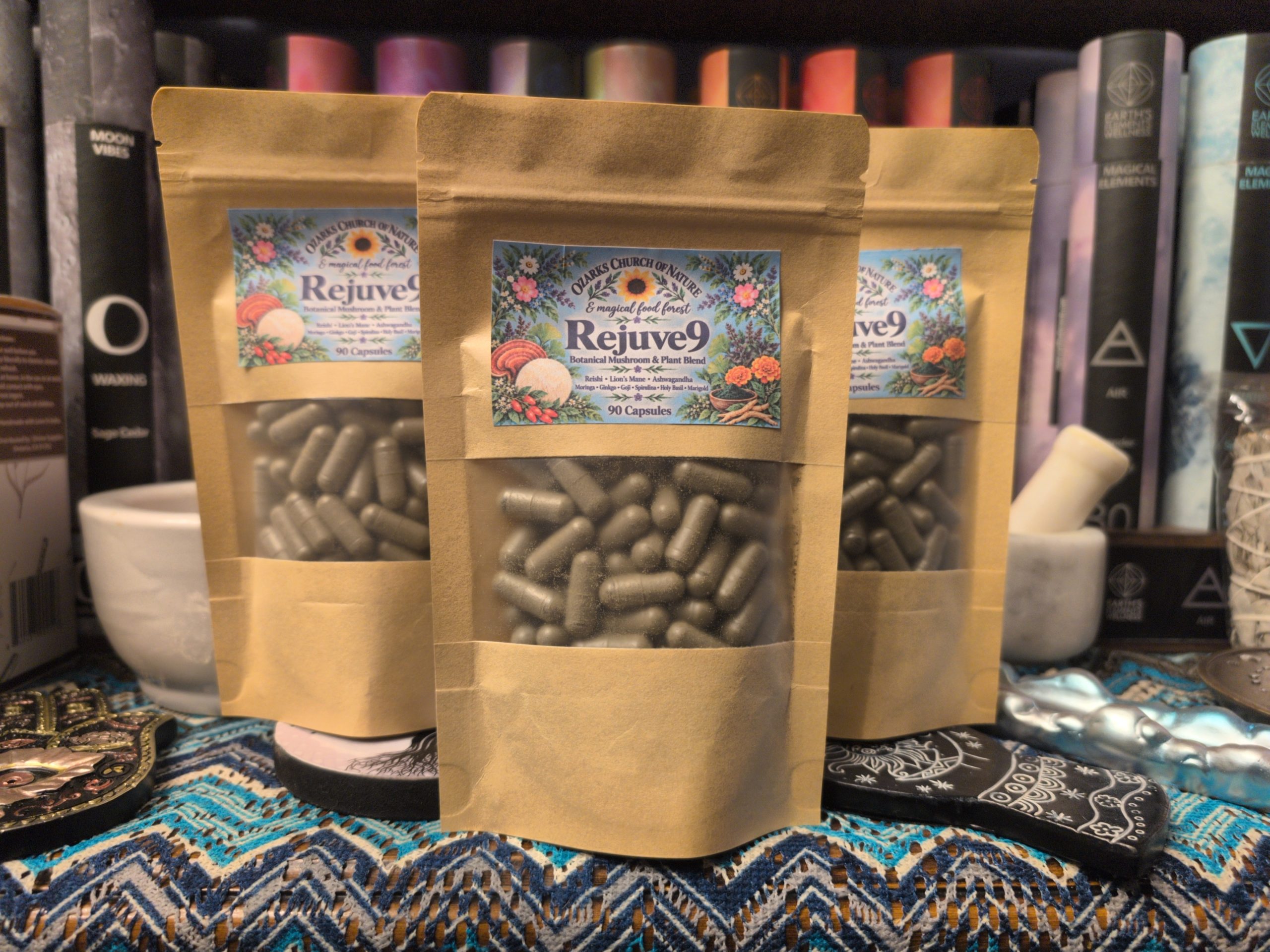
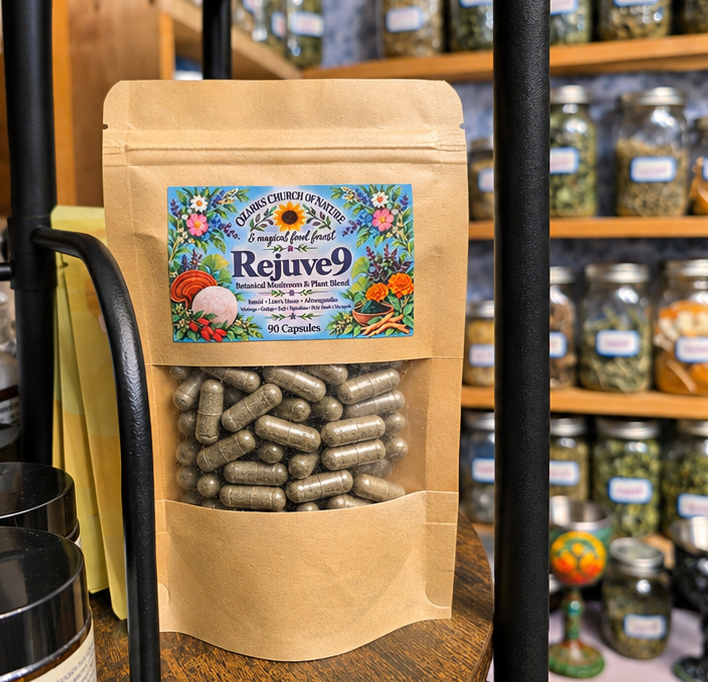
REJUVE9
Rejuve9: 9 Botanicals, Ancient Traditions & Modern Research
From The Herbal-Tique at Ozarks Church of Nature
90 Capsules | $29 | Small-Batch Botanical Supplement
Some of our favorite creations don’t happen overnight.
Rejuve9 has been a project throughout 2026, combining 9 fascinating ingredients from the botanical and mushroom kingdoms into one carefully prepared blend.
We began by sharing small batches with a handful of customers, learning about their experiences, and refining our preparation process. The encouragement of returning customers has inspired us to prepare Rejuve9 for a wider introduction.
From Our Gardens to Your Botanical Collection
What makes Rejuve9 particularly meaningful to us is its connection to the living gardens of Ozarks Church of Nature.
Our Holy Basil and marigold flowers are grown and harvested right here, while portions of our ashwagandha, moringa, and goji berries also come from our own gardens. The other herbs and mushrooms are sourced from trusted organic small growers.
As our gardens mature, we hope to grow and harvest even more of these remarkable botanicals ourselves.
From seed to harvest, every growing season brings us closer to that dream.
But there’s something we love even more than creating a new product: sharing what makes the plants themselves so fascinating!
So let’s meet the nine ingredients behind Rejuve9.
1. Reishi – The Mushroom of Longevity
Reishi has been treasured in East Asian herbal traditions for centuries. Often called lingzhi, it holds a special place in traditional Chinese botanical practice.
Reishi mushrooms contain complex polysaccharides, including beta-glucans, as well as triterpenes and other natural compounds.
Researchers have investigated these compounds for their interactions with immune cells and other biological processes. Much of this research remains laboratory-based or preliminary, and reliable evidence of clinical benefits is limited.
What makes reishi especially interesting is the complexity of its chemistry and its long cultural history.
2. Lion’s Mane – The Remarkable Tooth-Fungus Mushroom
With its cascading white spines, lion’s mane looks almost like something from an enchanted forest.
This edible mushroom has attracted considerable scientific interest because it contains compounds such as hericenones and erinacines.
Researchers have examined lion’s mane in relation to nerve growth factors, memory, attention, mood, and cognition.
Small human studies have produced mixed or preliminary findings, and larger, longer studies are needed. Nevertheless, lion’s mane continues to be an intriguing subject of mushroom research.
3. Ashwagandha – An Ayurvedic Botanical
Ashwagandha (Withania somnifera) has a long history in Ayurvedic practice.
Traditionally associated with vitality and resilience, this shrub contains naturally occurring compounds called withanolides.
Modern research has examined certain ashwagandha preparations in relation to perceived stress and sleep. Some clinical trials have reported encouraging findings, although results depend on the preparation, amount, and study population.
Ashwagandha also has important safety considerations, especially concerning pregnancy, thyroid and autoimmune disorders, medications, and rare reports of liver injury.
4. Holy Basil – The Revered Tulsi
Holy basil, also known as tulsi, has been grown and valued for generations throughout South Asia.
Its fragrant leaves are part of traditional herbal preparations and are associated with both culinary and spiritual practices.
Holy basil contains aromatic compounds and naturally occurring polyphenols. Researchers have studied standardized tulsi preparations in relation to stress, sleep, and other measures of well-being.
These studies concern particular preparations and cannot be assumed to describe the effects of every holy basil product.
We especially love holy basil’s wonderful fragrance and its place in the living botanical world.
5. Moringa – The Nutrient-Rich Tree
Moringa (Moringa oleifera) is a remarkable tropical tree whose leaves have long been eaten as a vegetable in many parts of the world.
The leaves contain plant protein, fiber, carotenoids, minerals, and a variety of naturally occurring phytochemicals.
Scientists are studying moringa’s nutritional composition and its potential role in food and nutrition.
Its actual nutrient content varies with growing conditions, plant parts, drying methods, and preparation. The presence of nutrients in moringa leaves doesn’t tell us how much is present in a finished capsule blend without testing.
6. Goji Berry – The Little Red Berry with a Long History
Goji berries, often associated with Lycium barbarum, have been used in traditional East Asian food and herbal preparations for centuries.
Their brilliant red-orange color comes partly from naturally occurring carotenoid pigments, including zeaxanthin.
One small human study investigated the effects of eating goji berries on macular pigment optical density, a measurement associated with pigments in the retina.
The researchers observed changes in this measurement, making it an interesting area for further study.
Importantly, that research did not establish that goji berries correct eyesight, eliminate the need for glasses, or produce the same results in a multi-ingredient capsule.
7. Ginkgo – The Ancient Tree
Ginkgo biloba is one of the botanical world’s extraordinary survivors, representing an ancient lineage of trees.
Its distinctive fan-shaped leaves are instantly recognizable.
Ginkgo leaf preparations have been studied for decades in relation to circulation, cognition, and several other health questions.
Despite extensive research, results for many proposed benefits remain uncertain or inconclusive.
Ginkgo also has important precautions, including interactions with certain medications and increased bleeding risk in some circumstances.
8. Spirulina – A Fascinating Blue-Green Organism
Spirulina is a familiar name for certain cultivated Arthrospira cyanobacteria, often called blue-green algae.
It has a remarkable nutritional profile, containing protein, pigments, and other naturally occurring compounds.
One of its best-known pigments is phycocyanin, which gives spirulina its characteristic blue-green coloration.
Researchers have investigated spirulina in nutrition and numerous areas of human health, but evidence for specific medical benefits remains limited.
Purity is particularly important because poorly controlled blue-green algae products can contain harmful contaminants.
9. Marigold – A Flower of Color and Chemistry
Marigolds are beloved for their brilliant gold, orange, and yellow blossoms.
Certain Tagetes species, especially Tagetes erecta, have attracted research interest because their flower extracts can contain carotenoids such as lutein.
Lutein and zeaxanthin are pigments also found in the human retina and are important subjects in nutritional eye-health research.
However, the amounts found in marigold flowers vary, and studies of standardized flower extracts cannot establish the amount or effects of lutein in an untested whole-flower powder.
We love marigolds for their beauty, botanical diversity, and the fascinating science behind their natural pigments.
Why We Created Rejuve9
At Ozarks Church of Nature, we believe that learning about nature should be as rewarding as growing it. Rejuve9 brings together nine distinctive ingredients, each with its own botanical story, traditions, and scientific questions.
We believe customers deserve to know what is in their products, understand the limits of available research, and make their own informed choices.
The Herbal-Tique at Ozarks Church of Nature and Magical Food Forest – Where Botanical Curiosity Meets Handcrafted Care.
Explore the Research
We encourage independent learning. These resources discuss individual ingredients and related research, not clinical testing of Rejuve9 itself.
Reishi – National Cancer Institute
https://www.cancer.gov/about-cancer/treatment/cam/patient/mushrooms-pdq
Lion’s Mane – Human Pilot Study
https://pubmed.ncbi.nlm.nih.gov/38004235/
Ashwagandha – NIH Research and Safety Information
https://www.nccih.nih.gov/health/ashwagandha
Holy Basil – Memorial Sloan Kettering
https://www.mskcc.org/cancer-care/integrative-medicine/herbs/holy-basil-01
Moringa – Scientific Review
https://pmc.ncbi.nlm.nih.gov/articles/PMC10944276/
Goji Berry – Human Pilot Study of Retinal Pigments
https://pubmed.ncbi.nlm.nih.gov/34959963/
Ginkgo – NIH Research and Safety Information
https://www.nccih.nih.gov/health/ginkgo
Spirulina – NIH LiverTox Reference
https://www.ncbi.nlm.nih.gov/books/NBK548312/
Marigold – Research on Lutein from Flowers
https://pmc.ncbi.nlm.nih.gov/articles/PMC11123982/
Important: This article is for botanical education. Research on individual ingredients, particularly extracts at specific doses, does not establish the effectiveness or safety of Rejuve9 as a finished product. Rejuve9 has not been clinically tested to treat, prevent, or cure any disease or to improve eyesight. Consult a qualified health professional about supplement use, especially if pregnant, breastfeeding, taking medication, or managing a medical condition.
Product release pending final formulation, safety, quality, and label verification.

Reviews
There are no reviews yet.